Catholic Saints Around the World: How Different Cultures Honor the Holy
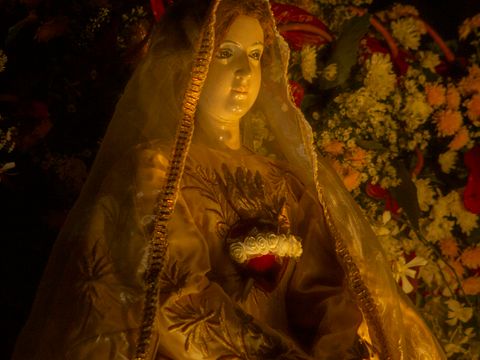
The Catholic Church is truly universal, and the way its 1.3 billion members honor saints reflects an extraordinary diversity of culture, tradition, and artistic expression. From Mexican altars covered in marigolds to Italian streets filled with parade floats, saint veneration takes on the color and character of every culture it touches.
Italy: Patron Saint Festivals (Feste Patronali)
Every Italian city, town, and village has a patron saint, and the festa patronale is often the biggest event of the year. In Naples, the liquefaction of Saint Januarius's blood three times a year draws enormous crowds. In Siena, the Palio horse race is dedicated to the Virgin Mary. And across southern Italy, saints' statues are carried through streets in elaborate processions.
At Catholically, we're based in Rome and experience this tradition firsthand. Every item we send ships from the heart of Italian Catholic culture.
Mexico: Día de los Muertos & Guadalupe
Our Lady of Guadalupe is the patroness of Mexico and the most widely venerated image of Mary in the Americas. On December 12, millions make pilgrimages to her basilica in Mexico City. The Día de los Muertos (Nov 1-2) blends Catholic All Saints'/All Souls' Days with indigenous traditions, families build home altars, visit cemeteries, and celebrate their departed loved ones.
Philippines: Sinulog, Black Nazarene, and Flores de Mayo
The Philippines is the most Catholic country in Asia. The Sinulog Festival in Cebu honors the Santo Niño (Child Jesus) with elaborate dances. The Black Nazarene procession in Manila draws millions. Flores de Mayo (Flowers of May) honors Mary with month-long celebrations.
Ireland: Saint Patrick & Celtic Catholic Traditions
Saint Patrick's Day (March 17) has gone global, but in Ireland it remains a deeply religious feast. Traditional practices include attending Mass, wearing shamrocks (which Patrick used to explain the Trinity), and visiting holy wells.

Latin America: Patron Saint Processions
Throughout Central and South America, procesiones (processions) with saints' statues are central to Catholic life. In Peru, the Señor de los Milagros (Lord of Miracles) procession is one of the largest in the world. In Colombia, Holy Week processions in Popayán are a UNESCO Intangible Cultural Heritage.
How to Honor Saints in Your Own Tradition
No matter your cultural background, you can draw from these rich traditions:
- Build a home altar with your patron saint's image
- Celebrate feast days with special meals and family prayer
- Wear your patron saint medal, a universal Catholic practice
- Pray the Rosary, beloved in every Catholic culture worldwide

Poland: The Black Madonna of Czestochowa
No discussion of global Catholic devotion is complete without Poland's Black Madonna of Czestochowa, one of the most revered icons in Christianity. Housed in the Jasna Gora monastery in Czestochowa since 1382, this dark-skinned painting of the Virgin Mary and Child is Poland's most sacred religious artifact. According to tradition, it was painted by St. Luke the Evangelist on a tabletop built by Jesus himself in the Holy Family's workshop in Nazareth.
The icon bears two distinctive slash marks on the Virgin's right cheek, said to have been inflicted by Hussite raiders in 1430 who, according to legend, were struck down by mysterious forces after attacking the painting. Despite multiple attempts to restore the scars, they reappeared each time, and they are now considered an integral part of the image's identity.
The Black Madonna has been central to Polish national identity for centuries. In 1655, the successful defense of Jasna Gora against a Swedish siege (the "Swedish Deluge") was attributed to her intercession, and King Jan Casimir subsequently crowned her "Queen of Poland." During the Nazi occupation and later the Communist era, the Black Madonna became a powerful symbol of resistance and hope. Pope St. John Paul II, himself Polish, made multiple pilgrimages to Czestochowa and credited Our Lady of Czestochowa with saving his life during the 1981 assassination attempt.
India: St. Thomas and the Roots of Indian Christianity
Christianity in India is not a product of European colonialism, it predates it by nearly 1,500 years. According to ancient tradition, St. Thomas the Apostle (the same Thomas who doubted Christ's resurrection) arrived on the Malabar Coast of India in 52 AD, making the Indian Christian community one of the oldest in the world.
The Syro-Malabar Catholic Church and Syro-Malankara Catholic Church, both Eastern Catholic churches in full communion with Rome, trace their origins directly to St. Thomas's mission. The apostle is said to have established seven churches along the Kerala coast before being martyred near modern-day Chennai in 72 AD. The Santhome Basilica in Chennai is built over what is believed to be his tomb.
Indian Catholic devotion blends universal Catholic theology with rich local cultural expressions: processions featuring elaborately decorated floats, the use of traditional oil lamps and flowers in worship, and the integration of classical Indian music into liturgical celebrations. The Feast of St. Thomas (July 3) is one of the most important celebrations for Indian Christians, drawing millions of pilgrims.
Korea: The Church Born Without Missionaries
The Catholic Church in Korea has a unique origin story: it is the only major Catholic community in the world that was founded entirely by lay people, without the involvement of foreign missionaries. In the late 18th century, Korean scholars studying in Beijing encountered Catholic texts and brought them home. They studied, debated, and eventually embraced the faith on their own, establishing a community before any priest had ever set foot in Korea.
This striking beginning was followed by one of the most brutal periods of persecution in Catholic history. The Korean Martyrs, 103 of whom were canonized by Pope John Paul II in 1984, endured horrific tortures and executions between 1839 and 1867. Many were ordinary laypeople: farmers, scholars, women, and children who refused to renounce their faith under extreme pressure.
Today, South Korea is one of the fastest-growing Catholic populations in Asia, with approximately 11% of the population identifying as Catholic. The Shrine of the Korean Martyrs at Jeoldusan ("Beheading Hill") in Seoul is a powerful memorial to their sacrifice.

Africa: The Uganda Martyrs and a Continent on Fire with Faith
Between 1885 and 1887, 45 young men, both Catholic and Anglican, were executed on the orders of Kabaka (King) Mwanga II of Buganda (modern-day Uganda) for refusing to renounce their Christian faith and submit to the king's sexual demands. The 22 Catholic martyrs were canonized by Pope Paul VI in 1964, becoming the first modern sub-Saharan African saints.
Among the most notable was St. Charles Lwanga, the chief of the royal pages, who protected younger pages from the king's advances and led them in their faith even as they faced execution. Many of the martyrs were teenagers, some as young as 14. They were burned alive at Namugongo, and their courage in the face of an agonizing death inspired a massive wave of conversions across East Africa.
Today, Africa is the fastest-growing region for Catholicism in the world. The continent's Catholic population has grown from approximately 2 million in 1900 to over 250 million today, and is projected to reach 460 million by 2050. The Namugongo Martyrs Shrine in Uganda draws over 3 million pilgrims annually for the June 3 feast day, making it one of the largest Catholic pilgrimages in the world.
Catholic Universality: One Faith, Many Cultures
The word "Catholic" itself comes from the Greek katholikos, meaning "universal." The diversity of Catholic expression around the world, from Polish icon processions to Korean lay-founded communities to African martyrdom to Indian apostolic roots, is not a contradiction of unity but its most beautiful expression.
The Church's genius lies in its ability to inculturate: to take root in every culture without being captive to any single one. The Mass is celebrated in over 1,100 languages. The Church includes 23 distinct "sui iuris" (self-governing) churches, each with its own liturgical tradition, from the Latin Rite to the Maronite, Coptic, Syro-Malabar, Ukrainian, and many others, all in full communion with the Bishop of Rome.
This universality is the living fulfillment of Christ's command to "make disciples of all nations" (Matthew 28:19). When a Catholic from Seoul kneels beside a Catholic from Kampala, a Catholic from Czestochowa, and a Catholic from Kerala, they share the same Creed, the same sacraments, and the same communion of saints. That is the miracle of Catholic universality.
To bring a piece of this universal Catholic heritage into your own home, explore our collection of items blessed by the Pope, sacred objects from the heart of the universal Church in Rome.
Frequently Asked Questions